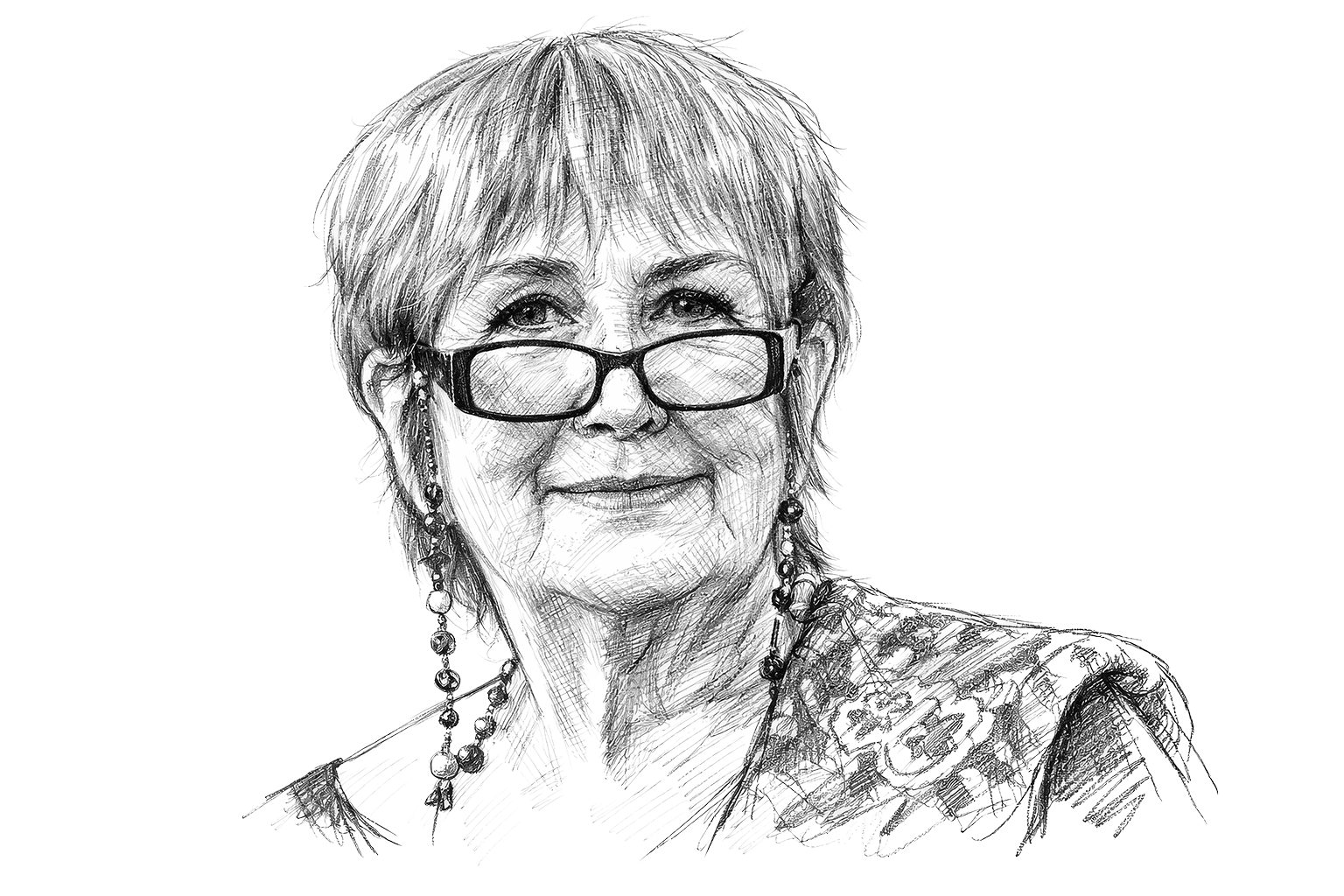

The Resonance of a Voice: Dame Jenni Murray and the Architecture of Modern Womanhood
12 May 1950 – 12 March 2026
The death of Dame Jenni Murray on March 12, 2026, at the age of seventy-five, marked the silencing of one of the most definitive, enduring, and complex voices in the history of British broadcasting. For more than three decades, her presence was not merely a predictable fixture of the daily radio schedule; it was a central pillar in the architecture of modern female identity in the United Kingdom. To understand her legacy—as is the mandate of Notes of Late—is to examine far more than a timeline of journalistic achievements or a catalogue of high-profile interviews. It is to explore the profound tensions of the twentieth and twenty-first centuries through the prism of one extraordinary life: the fierce realities of class mobility, the evolution of feminism, the politics and frailties of the female body, and the relentless demand for intellectual rigour in a world increasingly hostile to nuance.
As the longest-serving presenter of BBC Radio 4’s Woman’s Hour, a tenure stretching from 1987 to 2020, Murray transformed a program born of post-war domesticity into a formidable, unapologetic platform for sexual politics, global affairs, and uncompromising social inquiry. Her broadcast alchemy lay in an extraordinary equilibrium. She possessed a warmth that invited profound intimacy, coupled with a forensic, occasionally ruthless intellect that suffered no fools and permitted no evasions. This essay delves into the totality of her human experience—the struggles that shaped her, the controversies that tested her, and the triumphs that secured her place as a pioneer who forced a nation to pause, to listen, and to confront the unvarnished realities of a life fully lived.
The Crucible of Barnsley: Class, Accent, and the Burden of Ambition
Jennifer Susan Bailey was born in Barnsley, in the West Riding of Yorkshire, on May 12, 1950. Her origins were rooted deeply in the post-war working class, though her family was distinctly and anxiously upwardly mobile. Her father, Alvin Bailey, was an electrical engineer, and her mother, Winifred (Win) Jones, was a civil servant who had relinquished her career upon motherhood—a common trajectory of the era, but one that bred in Winifred a complex, lifelong resentment regarding her own thwarted potential.
Murray’s entry into the world was fraught with physical trauma. Her mother endured a harrowing twenty-four-hour labour, entirely on her back with her legs in stirrups, surviving an ordeal that brought both mother and daughter to the absolute brink of death. Consequently, Winifred resolved never to endure childbirth again. As an only child, the young Jenni became the singular, concentrated vessel for her mother’s intense, unfulfilled ambitions. Winifred was a woman of stark paradoxes. She had ardently wished for a boy—whom she planned to name David Robert—yet she spent hours meticulously styling young Jenni’s hair into pigtails, demanding she look the part of a pristine, delicate little girl.
The young Murray, however, was fundamentally and incorrigibly a tomboy. She favoured dungarees over dresses, harboured a deep fascination with guns and “cowboys and Indians,” and was entirely indifferent to the domestic arts of sewing, cleaning, or cooking. She once famously rescued her male best friend, John, from a local duck pond, reversing the gendered damsel narrative before she even possessed the vocabulary to articulate it. This inherent rebellion against domesticity infuriated her mother. On one memorable occasion, while being forced to scrub a grate, a young Murray let slip a profanity in her broad Yorkshire accent, declaring the task impossible, which resulted in a severe physical reprimand.
Yet, Winifred’s most profound and unintended gift to her daughter was the enforcement of elocution lessons. Driven by a profound fear of her daughter speaking like the other children on their council estate, and motivated by her own avid devotion to listening to Woman’s Hour, Winifred sent five-year-old Jenni to learn Received Pronunciation. The mother’s intent was to erase the provincial markers of class and secure social mobility, but the ultimate outcome was the forging of an instrument of immense broadcasting power. Murray’s voice—later described by the legendary presenter Charles Wheeler as “the most beautiful voice in the world”—became her ultimate weapon in conquering the British media establishment. It was an accent smoothed of its regional grit, yet it carried the undeniable, underlying fortitude of the North.
At the age of eleven, when her father was offered an engineering contract in Calcutta, India, Murray demonstrated an ironclad, independent will: she flatly refused to go. Insisting on remaining in England to attend Barnsley Girls’ High School—a grammar school that represented the pinnacle of her educational ambitions—she moved in with her maternal grandmother. This spatial separation from her parents during her turbulent teenage years was formative. Her grandmother was a warm, deeply indulgent figure who provided a necessary emotional refuge from Winifred’s exacting standards. However, this indulgence manifested largely through food; her grandmother kept an endless supply of wonderful cakes, chocolates, and sweets, effectively laying the psychological and biological groundwork for Murray’s lifelong, agonising battle with obesity.
Intellectual Awakenings and the Rejection of Dogma
Murray’s intellectual precocity was evident early; she was reading fluently by the age of three. Because she was so advanced, she was sent initially to a Catholic convent school, simply because it was the only institution that would accept a child of that age. There, she felt entirely alienated as a member of the Church of England, likening her experience to being treated as a “heathen”. Though she experienced a brief period of passionate religious devotion in her early teens, two specific incidents irrevocably shattered her faith. First, she witnessed a nun flagrantly lie about physically disciplining a child with a belt buckle; second, a vicar insisted to her that germs could not be transmitted via a consecrated communion cup. Finding such claims intellectually insulting and “nonsensical,” Murray definitively turned her back on religion, adopting a steadfast humanist and atheist worldview that would guide the remainder of her life and eventually lead to her patronage of Humanists UK.
A profound shift in her identity occurred at the age of fifteen. During a poignant trip to the Auschwitz concentration camp with her father, he revealed a long-kept family secret: his mother was Jewish. Murray realised with a shock that her own mother had deliberately hidden this heritage, desiring to assimilate entirely into conventional English society. This revelation of her Jewish lineage deeply affected her, prompting her to spend a year living in Israel during her university studies, though she would later express deep disillusionment with the region’s geopolitical realities and settlement expansions.
It was also during her mid-teens that the seeds of her feminist consciousness were sown. Observing the stark domestic inequalities in her own home—watching her mother return from a full day of work only to immediately begin household chores, while her father sat down to comfortably read the newspaper—she confronted him. She boldly demanded that he do his “share,” cementing her lifelong intolerance for domestic subjugation. This refusal to accept the subjugation of women as a natural law propelled her to the University of Hull, where she studied French and Drama, graduating into a world she was determined to interrogate and reshape.
Navigating the Patriarchal Labyrinth of 1970s Media
Murray’s ascent into the upper echelons of journalism was not frictionless. She joined the BBC in 1973, initially at Radio Bristol, moving from a humble copytaker to a producer and presenter. She transitioned to television, serving as a reporter and presenter for South Today between 1978 and 1983. Her sheer competence, rigorous preparation, and commanding presence elevated her to the national stage, landing her high-pressure roles on BBC Two’s Newsnight (1983-1985) and Radio 4’s flagship morning program, Today.
The newsrooms of the 1970s and 1980s were fiercely patriarchal ecosystems, resistant to female authority. The Today program during that era was inveterately sexist; male presenters dominated the hard political interviews and economic analyses, while female broadcasters were routinely relegated to mopping up the softer, human-interest segments. On Newsnight, women were so rare they were often dismissively referred to by male colleagues as “the wives”. Murray, however, possessed an authoritative timbre and a relentless intellect that could not be easily sidelined. While colleagues praised her “mellifluous” and “rounded” tone, beneath the velvet lay undeniable steel. She quickly established herself as a formidable broadcaster who combined natural empathy with an incisive, probing interview style that left politicians nowhere to hide.
Her personal life during this ascent reflected the practical, often difficult compromises demanded of ambitious women of her generation. In 1971, she married Brian Murray, a fellow student at Hull University. By her own later admission in her highly candid memoirs, the marriage was hastily undertaken primarily to circumvent the absolute “fury” her mother would have unleashed had she discovered they were cohabiting out of wedlock. The union ended in divorce seven years later. She later formed a lifelong, enduring partnership with David Forgham, a naval officer.
Following the birth of their two sons, Edward (Ed) and Charlie, Murray and Forgham made an unconventional but necessary choice for the era: Forgham left the navy to assume the role of primary caregiver, allowing Murray to pursue her demanding, high-profile broadcasting career without the impossible burden of managing childcare. This arrangement necessitated a gruelling geographic partition. While the family resided in a farmhouse in Cheshire (and later the Peak District), Murray lived in a small, cramped basement flat in Camden during the working week, a residence she wryly and affectionately dubbed “Wuthering Depths”. She would commute north on weekends to be with her family. This sacrifice—enduring the profound isolation of her subterranean London flat to provide financially while a man raised the children—was a radical inversion of the gender norms of the 1980s. It served as a living testament to the feminist principles of equality and shared domestic responsibility she would soon champion on the national airwaves.
The Sisterhood of the Airwaves: Redefining Woman’s Hour
In 1987, Murray took the helm of Woman’s Hour, succeeding Sue MacGregor. When the program originally launched in 1946, its mandate was strictly domestic: it provided cooking advice, cleaning tips, and romantic serials designed to occupy the post-war housewife. Under Murray’s visionary stewardship, and alongside determined editors like Sally Feldman, the average age of the production team plummeted, and the show’s ethos shifted dramatically. Woman’s Hour was consciously remade into an unapologetic, feminist space that treated women’s issues with unprecedented gravity, moving from a “cosy daily chat” to an “agenda-setting exploration of life”.
She’d hypnotise her guests into telling her what they perhaps didn’t always want to tell her.
Murray reshaped the program in her own image. Nothing was deemed too serious, nor too frivolous; she understood that the totality of a woman’s life encompassed both the profound and the mundane. She could pivot seamlessly from a discussion on pruning hydrangeas to campaigning against domestic abuse, genital mutilation, marital rape, and the biological complexities of the menopause. By 1996, her influence was so profound that The Sunday Times accurately characterised the show as “Radio 4’s sisterhood of the airwaves”.
The Architecture of the Interview
Murray’s interviewing technique was legendary across the industry. Sally Feldman described it as “hypnotic”—a conversational style that lulled guests into a false sense of security before forensically extracting truths they had absolutely no intention of revealing. She prepared meticulously, yet her delivery remained direct, unyielding, and largely devoid of the aggressive posturing favoured by her male counterparts.
Her encounters with global power brokers demonstrated her absolute refusal to be intimidated by rank or reputation. In 1990, during Margaret Thatcher’s final broadcast interview as Prime Minister, Murray dismantled the Conservative leader’s ideological framework regarding childcare. Murray pressed Thatcher on the government’s failure to provide accessible, affordable childcare to hasten gender equality, pointing out the statistical reality that women were the exact demographic from which Thatcher was haemorrhaging the most support. When Murray asked if this was due to a fundamental lack of understanding of women’s specific difficulties, Thatcher floundered, admitting, “I don’t know”—a phrase she had seldom uttered in her long political career. Murray later noted that Thatcher was entirely unprepared for this line of questioning, having been shielded from the true extent of her unpopularity among women by her press secretary, Bernard Ingham.
When anybody ever asked her if she was a feminist she’d always say ‘I’m a journalist’ but everything she did was to stand up for women.
Murray’s fearlessness extended to moral and personal probing. When interviewing former Conservative MP Edwina Currie in 2002 regarding her affair with John Major, Murray opened the broadcast by listing the exact, misogynistic insults hurled at Currie by the tabloid press: “a cheat, a grade-A trollop, a total cow and the cheapest kiss-and-tell hawker”. She then ruthlessly interrogated Currie not on the affair itself, but on the feminist ethics of exposing another woman’s (Norma Major’s) private humiliation to the public sphere for profit.
She did not flinch before American political royalty, either. She bypassed standard diplomatic rhetoric to directly ask Hillary Clinton, “What is it about Bill that has enabled you to forgive his infidelities?” Furthermore, she famously charmed the notoriously difficult Hollywood icon, Bette Davis. Davis was one of the few women Murray admitted to being terrified of—the other being Thatcher—due to her “piercing eyes” that could seemingly detect a poorly researched question instantly. Yet Murray won her over, persuading the octogenarian to recreate iconic lines from All About Eve. Despite these monumental encounters, Murray often cited her interview with the folk singer Joan Baez—who sang “Diamonds and Rust” live in the studio—as the absolute “peak of my career”.
Despite her overt championing of women, Murray was highly particular about her professional labelling. When inevitably asked if she was a feminist, her standard, fiercely protective retort was, “I’m a journalist”. She believed that the search for truth and justice required an objective lens, yet her definition of journalism inherently demanded the dismantling of systemic sexism and the illumination of dark corners.
| Key Woman’s Hour Interviews | Significance and Interview Approach |
| Margaret Thatcher (1990) | Exposed the Prime Minister’s disconnect from working mothers; forced a rare admission of ignorance (“I don’t know”) regarding childcare policies. |
| Hillary Clinton (2014) | Bypassed standard political rhetoric to directly question the personal and feminist implications of forgiving marital infidelity. |
| Edwina Currie (2002) | Confronted the ethical paradox of a female politician profiting from a memoir that publicly humiliated another woman (Norma Major). |
| Bette Davis (1987) | Navigated the fearsome reputation of the Hollywood legend, demonstrating Murray’s ability to handle highly intimidating personalities. |
| Joan Baez | Considered by Murray to be the “peak” of her career, culminating in a live studio performance. |
The Battle of the Body: Weight, Misogyny, and Medical Reality
Perhaps Murray’s most radical act of broadcasting—and the truest measure of her sympathy for the human condition—was her refusal to separate the intellect of the presenter from the biological reality of the female body. She transformed her personal physical traumas into matters of vital public discourse, stripping away the shame that historically shrouded women’s health.
Isn’t it curious that so many things are included in hate crime, but what’s the one thing that’s not? Obesity.
For her entire adult life, Murray fought a highly visible, agonising battle with obesity. Her weight, which eventually reached 24 stone (152kg), was a source of profound physical and psychological pain. It was intrinsically linked to her childhood—the cake-filled afternoons with her indulgent grandmother, juxtaposed with the cruelty of her mother, who insisted she finish every plate in a post-war “eat everything” mentality, yet fat-shamed her mercilessly. When Murray returned from her first year at university two stones heavier, her mother angrily compared her to a “baby elephant”. As a student, her drastic weight loss was briefly achieved through the unwitting use of “Black Bombers”—powerful amphetamines prescribed as diet pills, highlighting the perilous medical culture surrounding women’s bodies.
The isolation of her working life in London’s “Wuthering Depths,” where she self-soothed with takeaways, pre-prepared food, and wine away from the comfort of her family, severely exacerbated her condition. She admitted to lacking an “off switch” and using food for friendship when lonely.
Murray became a fierce, articulate critic of the diet industry and the societal treatment of the obese. She articulated how fat-shaming operated as an unacknowledged hate crime, recounting the routine abuse she received from men on the street who would shout derogatory terms like “Fat cow” as she walked her dogs or waited at traffic lights. Recognising that her weight had become a genuine disability threatening her life—preventing her from walking comfortably and raising the spectre of type 2 diabetes—and prompted by a stark warning from her son, she underwent bariatric metabolic surgery (a gastric sleeve) in 2014. She shed half her body weight in a year.
She detailed this arduous journey in her unapologetic 2020 book, Fat Cow, Fat Chance: The Science and Psychology of Size. In it, she dissected the intersection of genetics, emotional eating, gut microbiomes, and systemic misogyny, dismantling the cruel societal narrative that obesity is merely a failure of “moral fibre”. Even in her seventies, she remained transparent about her ongoing struggles, openly discussing her later use of weight-loss drugs like Wegovy to combat weight regain, refusing to view pharmacological assistance as “cheating”.
The Year of Agony: Grief, Cancer, and the Right to Die
The year 2006 tested the limits of Murray’s resilience, plunging her into a period of unimaginable dual trauma. Her mother, who had suffered for a decade from the ravages of Parkinson’s disease, passed away. Winifred’s decline had been agonising to witness. The disease robbed her of her mobility, freezing her once-expressive face into a blank mask, and most cruelly, slurring her crisp, articulate speech—the very attribute she had so desperately cultivated in her daughter.
Because of a law that is cruel and inhumane, my mother died alone in the night with no one who loved her at her side.
Murray frequently experienced the cruelty of the public while caring for her mother; people in supermarkets would shove past them, and strangers would ask if her mother was drunk, forcing Murray to furiously defend her. Most hauntingly, as her dignity vanished and the pain intensified, her mother repeatedly whispered, “Jen, please, help me. Help me die.” Bound by the law, Murray was powerless to assist, an impotence that ignited her fierce, lifelong campaign for assisted dying. She cited cases like David Hunter, who faced legal ruin for ending his terminally ill wife’s suffering, arguing that the current laws were “cruel and inhumane”.
In a twist of profound cruelty, on the exact day her mother died, Murray was informed that a routine mammogram had detected breast cancer. Murray announced her diagnosis live on air, refusing to hide her vulnerability. True to her humanist principles, she utterly rejected the prevailing cultural narrative that cancer patients must engage in “positive thinking” to survive, finding the concept coercive and unscientific. She demanded the right to confront her illness rationally, undergoing a double mastectomy and chemotherapy without the burden of enforced optimism. She chronicled the agony of this period in her acclaimed book, Memoirs of a Not So Dutiful Daughter, which served as both an exploration of profound grief and a reckoning with her mother’s complex, suffocating love.
The Mother and the Matriarch: Raising Sons in a Feminist Paradigm
Despite the demands of her career, Murray was deeply devoted to her two sons, Ed and Charlie. Her relationship with them was characterised by a robust, loving combativeness. She often noted that she was not inherently “good with small children,” preferring their company as they grew into independent, interesting adults. She recalled a terrifying incident in the South of France when a two-year-old Charlie went missing from the beach; after police were called and radio broadcasts made, he was returned two hours later, having likely hidden behind a pile of postcards as a joke.
She fiercely resisted gender stereotyping with her sons, occasionally to comedic effect. When Charlie took her on a terrifying, boiling-hot rally driving experience, she retaliated by dragging him, kicking and screaming, to a three-hour ballet performance—a “torture chamber” that left him feeling entirely “de-masculated”.
As she aged, she confronted the societal expectation of grand-motherhood. While she briefly harboured a fantasy of spoiling a granddaughter just as her own grandmother had spoiled her, she made absolute peace with her sons’ decisions not to reproduce, refusing to interfere or express disappointment, asserting that her active working life provided ample fulfilment.
Her sons remained a central pillar of support. In September 2025, they helped her fulfil a lifelong dream of visiting Pompeii. Since she was twelve years old, Murray had harboured a terror of Mount Vesuvius, instilled by her Latin mistress, Miss Pilling, whose graphic descriptions of the pyroclastic flow and plaster casts of victims caused decades of nightmares. Despite her poor mobility from arthritis and a broken back, Ed and Charlie organised the logistics, pushing her wheelchair over the bumpy, ancient Roman roads to view the House of Julia. It was a poetic closure for a woman who had spent her life confronting fears, made possible by the men she had raised.
Ideological Collision: The Transgender Controversy and Cancellation
Murray’s feminism was forged in the fires of the second wave; it was intrinsically tied to the biological realities of the female body—menstruation, childbirth, menopause, and the specific societal violence enacted upon women because of their sex. This foundational belief ultimately brought her into direct, explosive conflict with modern identity politics.
I made the decision a year ago when it became clear to me that it was time to move on and be free of the leash which, in recent years, had caused me to be what I can only describe as ‘cancelled’.
In early 2017, Murray interviewed transgender activist India Willoughby on Woman’s Hour. Murray was aghast that Willoughby clung to what Murray viewed as archaic, stereotypical notions of femininity (such as wearing makeup and shaving legs) while lacking an understanding of the historical political struggles of women. Compelled to speak out against what she perceived as the misogyny of trans ideology, Murray penned a deeply controversial article for The Sunday Times Magazine in March 2017 titled, “Be trans, be proud – but don’t call yourself a ‘real woman’”.
In the piece, she argued forcefully that individuals who had grown up enjoying the privileges of male socialisation could not simply undergo surgery, “shop in a different section of the department store,” and claim the lived experience of womanhood. She vehemently defended the necessity of single-sex spaces and rejected “inclusive” language proposed by the British Medical Association, such as “chest-feeding,” citing the stark biological reality of her own breasts, of which she had lost to cancer.
The backlash was instantaneous and ferociously punitive. Activist groups labelled her views “hurtful,” and she was subjected to extreme online abuse. Student unions at institutions like Oxford University and the University of Hull protested her appearances, with the latter cancelling plans to name a lecture theatre in her honour, declaring her unfit as a “role model”.
Crucially, the BBC, buckling under intense activist pressure, issued a swift reprimand. The corporation formally warned Murray to adhere to impartiality guidelines, effectively placing a gag order on her ability to lead any discussions regarding transgender issues on Woman’s Hour. For a broadcaster whose entire career was built on fearless, impartial inquiry into the most controversial topics of the day, this censorship was deeply humiliating.
The institutional betrayal fractured her relationship with the BBC. The situation worsened when she was barred from covering the 2019 general election due to anti-Brexit views she had expressed in print. In October 2020, Murray stepped down from Woman’s Hour after 33 years. Writing subsequently in the Daily Mail, she revealed the true catalyst for her departure: she desired to be “free of the leash” that had caused her to be “cancelled” by the very corporation she had served for decades, noting she could no longer tolerate the atmosphere created by management bowing to Twitter mobs. She departed to the strains of Helen Reddy’s feminist anthem, I Am Woman, a defiant final note from a broadcaster who refused to compromise her definition of the term.
The Historian’s Pen: Rewriting the National Narrative
Liberated from the constraints of BBC impartiality, Murray expanded her footprint as a writer and historian. Her bibliography is extensive, spanning memoirs, explorations of menopause, and tributes to her beloved dogs. However, her most ambitious intellectual project was A History of Britain in 21 Women, published in 2016.
The book was a direct, philosophical refutation of the 19th-century historian Thomas Carlyle, who famously posited that “The history of the world is but the biography of great men”. Murray sought to dismantle this patriarchal historiography by elevating women whose contributions had been erased or minimised by male academics. She noted her frustration with modern textbooks that relegated the suffragettes to a mere quarter of a page.
Her selection methodology was highly intentional. She largely eschewed women who merely inherited power (such as Queen Victoria or Elizabeth II), focusing instead on those who achieved greatness through relentless struggle and the defiance of prejudice. Her curation spanned millennia, from Boadicea to Nicola Sturgeon, highlighting pioneers in science, arts, and politics. She included figures like Aphra Behn, the first woman to earn a living as a playwright, and Mary Seacole, ensuring intersectional representation. Her exclusion of birth control pioneer Marie Stopes—specifically due to Stopes’s repugnant views on eugenics—demonstrated Murray’s refusal to blindly lionise historical women without moral scrutiny.
| Selected Bibliography | Thematic Focus |
| Memoirs of a Not So Dutiful Daughter (2009) | An exploration of her complex relationship with her mother, grief, and the intersection of Parkinson’s disease and breast cancer. |
| Fat Cow, Fat Chance (2020) | A scientific, psychological, and deeply personal investigation into obesity, fat-shaming, and the diet industry. |
| A History of Britain in 21 Women (2016) | A historiographical corrective highlighting female pioneers who overcame prejudice to shape the nation. |
The Final Act: Saga, Experience, and the Humanist Departure
In her post-BBC years, Murray found a welcoming intellectual home at Saga Magazine, where she penned a highly popular monthly column for five years. Her writings resonated deeply with an older demographic, tackling the indignities and amusements of ageing with her trademark candour. She excoriated the catastrophic collapse of NHS dentistry, detailing the horrors of “DIY dentistry” where desperate patients pulled their own teeth with pliers, and revealing she had spent £30,000 of her mother’s inheritance on implants to fix teeth ruined by chewing biro pens as a young journalist. She lamented the decline of the Royal Mail, comparing it to Denmark’s cessation of letter deliveries, while fondly recalling her days as a student postie carrying heavy bags through the snow. She wrote hilariously of the sheer annoyance of requiring four different pairs of spectacles—distance, reading, computer, and sunglasses—tracing her deteriorating vision back to her mother, who was mocked as “speccy-four-eyes”.
She retained her capacity to shock and delight her audience, famously penning a viral column about joining the “Mile High Club” in a private plane over New York in 1980 with a wealthy young man, engaging the autopilot to complete the encounter. Yet, she also documented profound vulnerabilities. In late 2025, she wrote a harrowing account of a hospital stay for a severe chest infection and Covid-19. She endured “corridor care” at the Royal Free Hospital, sleeping in a squishy blue plastic chair overnight. The ordeal was compounded when a trainee nurse broke a cannula, leaving a piece of plastic embedded in her hand that required surgical removal by a vascular team.
In late 2025, she returned to the microphone to host the Saga podcast Experience is Everything, interviewing older celebrities like Prue Leith (on love in her seventies and assisted dying) and Tim Spector (on gut microbiomes, which prompted Murray to start eating his 35-plant mix) about the lessons gleaned from long lives. It was a triumphant return to form; she noted it was “good to be back where I feel at home,” exercising the same incisive empathy that had defined her prime, bonding with her studio minder Kate Randall.
Privately, her final years were marked by a serene acceptance of her circumstances. She lived in Hampstead Garden Suburb with her chihuahuas, Minnie and Maggie, and a Burmese cat named Soo, having forged a peaceful existence. Though she and David Forgham no longer lived together, they remained close friends who spoke often.
When her own end came in March 2026, she faced it with the rational, humanist clarity she had championed all her life. She viewed death not through a lens of religious comfort, but as a biological reality that demanded dignity and autonomy.
The Shape of a Completed Life
Dame Jenni Murray did not merely broadcast to the nation; she forced the nation into a dialogue with itself. She navigated the transition of women from the domestic margins to the centre of public life, serving as both a guide and a vanguard. Her refusal to be categorised simply as a feminist, insisting instead on the rigorous, objective mantle of a journalist, allowed her to infiltrate the establishment and dismantle its biases from within.
She leaves behind an indelible legacy: a testament to the power of a perfectly modulated voice asking the most difficult, dangerous questions. In her triumphs over institutional sexism, her battles with her own physical vulnerabilities, and her refusal to surrender her principles to the shifting winds of modern ideological orthodoxy, Murray embodied the very essence of a life fully and courageously lived. In the quiet that follows her passing, the echoes of her interrogations—and her insistence on the unvarnished truth of the female experience—will resonate for generations to come.
Leave a Reply